Case study · DEGIS Buddy Program
1,171 registrations. No paid ads.
How the DEGIS Buddy Program beat its target in five weeks by turning volunteers, partners and a reusable campaign kit into distribution.
Jul – Oct 2026 · Buddy Program Coordinator · DEGIS, a nonprofit student network with 40+ city chapters
The quick read
- Challenge
- 1,000 registrations and 700 matches in five weeks, with no paid ads.
- Insight
- DEGIS already had distribution nobody was using as one system: volunteers in 40+ cities and partners with their own mailing lists.
- What I did
- I planned the content calendar backwards from the deadline, built a reusable kit for the city chapters, set up segmented partner mailings, ran three emails and the Instagram feed, and brought in two creators.
- Result
- 1,171 registrations and 1,017 matched students, both above target.
- What I'd change
- Recruit Veterans city by city from day one. 145 students were still waiting for a match at the end.
The challenge
Starting life in Germany means a new city, a new language and a lot of paperwork. The DEGIS Buddy Program pairs students who have just arrived (Newbies) with students who have been here a while (Veterans). The campaign line was "No one starts alone."
The goal was 1,000 registrations by 20 September at 23:59, and 700 students matched by the end of the month. Registration opened on 17 August, which gave us about five weeks.
What I had to work with:
- ▸No budget for paid ads.
- ▸A small list of our own: about 3,600 newsletter contacts, and only 262 of them identifiable as recent Newbies.
- ▸19,000 Brevo credits to last until 8 September, enough for roughly 7,000 recipients per email.
- ▸A registration platform the team had never used before.
- ▸A volunteer team, not an agency. One designer approved every visual, and one person owned the platform and the terms.
The baseline was the 2025 edition: 851 registrations from 70 countries.
What I saw before planning
Last year's numbers showed where sign-ups actually came from. Partner mailings and the DEGIS email list together brought about 71% of the 851 registrations. Instagram brought 129. TikTok and LinkedIn brought 8 each.
Past Buddy Program emails opened well, 29% for the last announcement, but only 4.2% clicked through. Registrations had always picked up mid-campaign and peaked in the last week, not at launch. And the students I needed most were still abroad, out of reach of our own list.
Social builds awareness. Email and partners turn it into sign-ups.
So I planned around three ideas. Reach Newbies through the partners who already talk to them before they arrive. Use social media for awareness, and email and partners to convert. Recruit Veterans through the chapters, because a Newbie can only be matched with a Veteran in the same city.
Four engines
Instead of adding one more channel, I ran four that fed each other.
| Engine | What it was | Why |
|---|---|---|
| Partners | Expatrio mailed its own lists: an announcement and a reminder, each in a Newbie and a Veteran version. | Reaches students before they arrive. |
| City chapters | A reusable media kit so each volunteer chapter could announce the program in its own city. | Reaches Veterans in small cities. |
| Our own channels | Three emails to the DEGIS list and the Instagram feed, with Facebook and LinkedIn in support. | Builds trust and converts. |
| Creators | One collaboration reel and one story share in mid-September. | Reaches people who don't follow DEGIS. |
City chapters
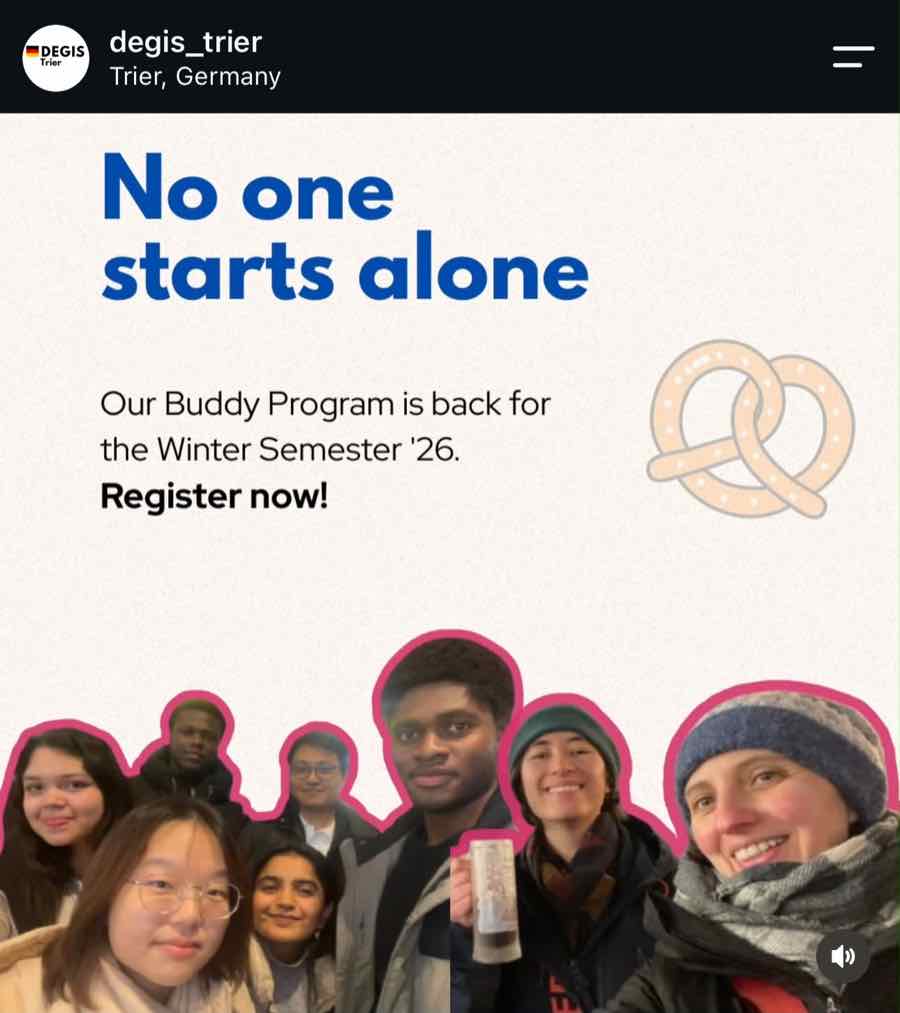
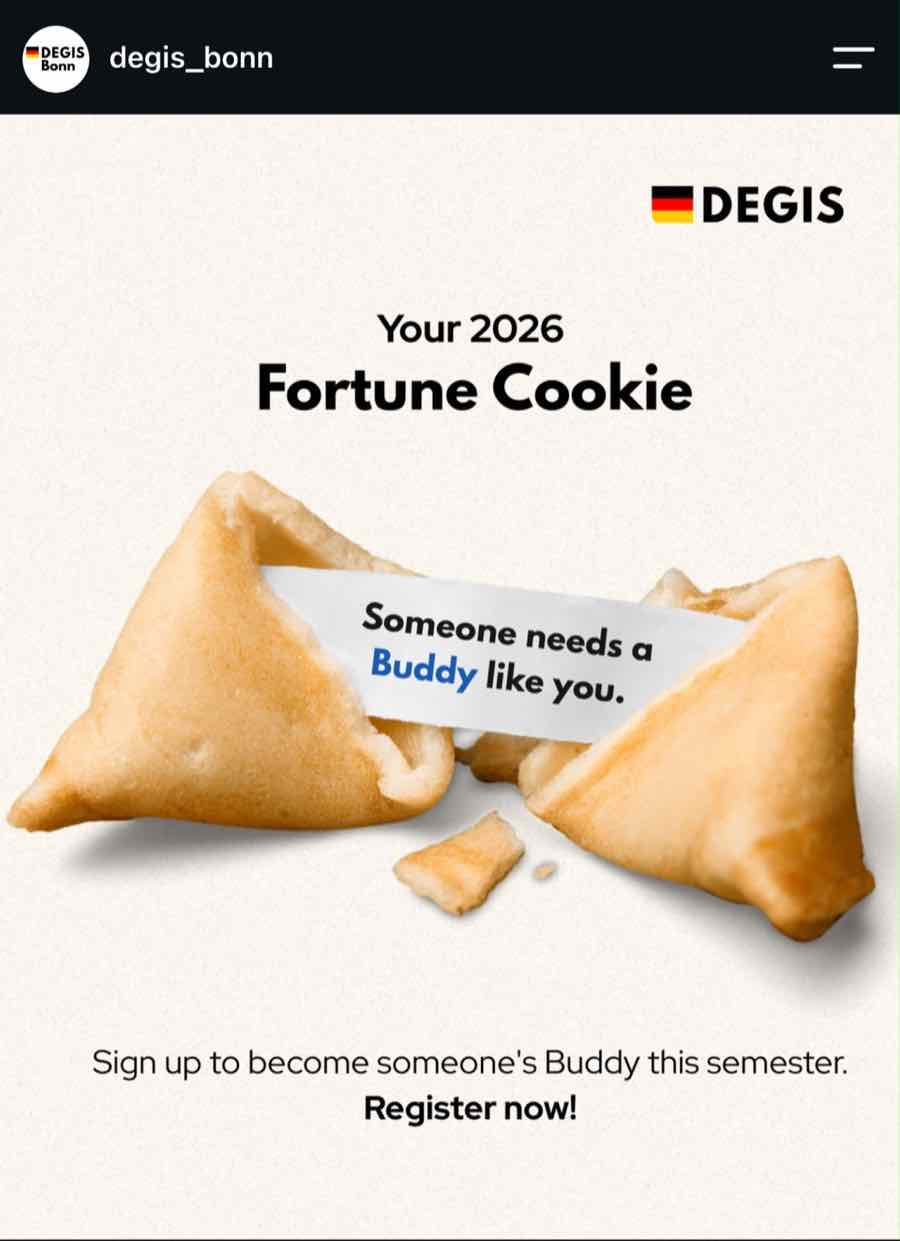
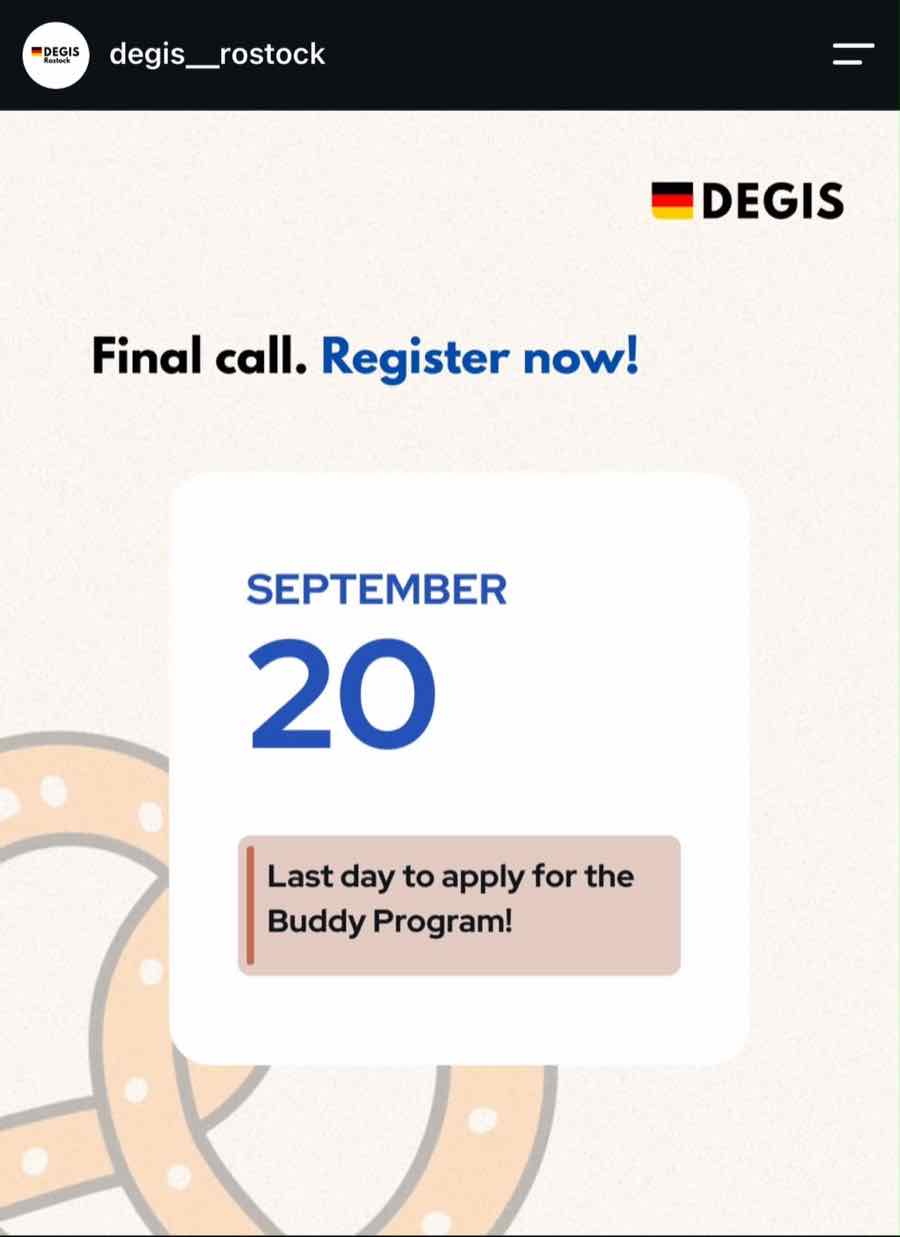
Matching only works if a Newbie has a Veteran in the same city, and our own channels barely reached small university towns. So I gave every volunteer chapter a ready-made kit: posters, and a post template with their city name and chapter logo. Each chapter could post locally without any design work.
Chapters such as Trier, Bonn and Rostock posted it. Veterans signed up from 78 cities, including small towns like Schmalkalden, which ended with 5.
The content calendar, planned backwards
I started from the 20 September deadline and worked back: a teaser on 14 August, launch on 17 August, then three posts a week. Every post had one job.
- ▸The basics every newcomer asks about: what it is, who can join, how matching works.
- ▸Peer-voice posts about the things nobody tells you before moving to Germany.
- ▸Proof and testimonials.
- ▸A separate stream of posts for Veterans.
- ▸The countdown: "one week left" on 14 September, "one day left" on 19 September, then the close.
In total, 22 Instagram posts: 9 reels, 6 carousels and 7 single images.

Email: one plan, two audiences
Newbies and Veterans are asked to do opposite things. One accepts help, the other gives it. So every email spoke to each group on its own terms.
Partner emails went out through Expatrio, two per audience: an announcement and a reminder. The Newbie version reached students arriving in September and October 2026, the Veteran version students who had arrived since January.
Our own emails were three sends, each with a Newbie section and a Veteran section and a button for each. The audience came from past Buddy Program lists, volunteer sign-ups and newsletter subscribers, minus unengaged contacts. Splitting every email by audience wasn't worth the credits: only 262 contacts were recent Newbies.
| Subject line | Delivered | Opened | Clicks | Click-to-open | |
|---|---|---|---|---|---|
| Announcement, 18 Aug | Buddy Program registrations are now open! | 6,061 | 40.5% | 377 | 15.4% |
| Social proof, 2 Sep | 1,780+ people from 96+ countries did this. Here's what happened. | 5,106 | 34.6% | 80 | 4.5% |
| Last call, 17 Sep | Last call: registration closes Sep 20! | 5,031 | 34.6% | 97 | 5.6% |
Every subject line was A/B tested on open rate, and version B won all three times. Last year's announcement opened at 29% with a 4.2% click-through, so this year's launch email did better on both.
The kit
- ▸A teaser and a launch carousel, on 14 and 17 August.
- ▸A content calendar at three posts a week.
- ▸Three emails to the DEGIS list, on 18 August, 2 September and 17 September.
- ▸Four partner emails: an announcement and a reminder, in Newbie and Veteran versions.
- ▸The city chapter kit: a registration poster, a Veteran call poster, a deadline poster, a post template with a city-name field and the chapter logo, and a caption bank.
- ▸A website header, a newsletter header, a LinkedIn launch post and community chat messages, so every channel said the same thing.
Results
| Goal | Target | Actual | Difference |
|---|---|---|---|
| Registrations by 20 Sep | 1,000 | 1,171 | +171 (17% above) |
| Students matched by 27 Sep | 700 | 1,017 | +317 (45% above) |
| Against the 2025 edition | 851 | 1,171 | +38% |
Of the 1,171, 905 were Newbies and 266 Veterans, and 9 withdrew.
Registrations came in two spikes, the launch and the deadline, with a dip between them. 510 registrations, 44% of the total, arrived in the last week.
Channel by channel
| Channel | What the exports show |
|---|---|
| 22 posts, 45.6K views and 476 shares. Reels brought 53% of the views and 83% of the shares. The top reel, on 14 September, reached 9,524 views and 360 shares. | |
| 20 posts, 3.5K views. | |
| 3 posts, 1,621 impressions, 37 clicks. |
Meta Business Suite shows 0 views from ads on Instagram and Facebook between 14 August and 23 September.
What these numbers can't tell me
- ▸Source is self-reported. People tick one box, so someone who saw a post and then got a partner email counts once.
- ▸I can't say which channel caused which registration, and the Instagram numbers cover the DEGIS account only, not the creators' reach.
- ▸Email opens are inflated by Apple Mail privacy protection, so clicks are the safer signal.
- ▸The final-week spike had overlapping causes: the partner reminder, the last email, the creator reel and the deadline itself.
What worked, and what didn't
What worked
- ▸A partner with direct access to newly arrived students did most of the reaching, and our own channels reinforced it.
- ▸The launch and the final week produced the two biggest spikes. Deadlines and reminders drove action.
- ▸Reels earned most of the views and shares on the DEGIS account.
- ▸Recruiting Veterans through the chapters brought sign-ups from 78 cities.
What didn't
- ▸Matching by location. 145 people were still waiting at the end, 122 of them Newbies, and 105 of those lived in cities with no Veteran. There were enough Veterans overall. They lived in the wrong places.
- ▸The mid-campaign dip. Only 45 registrations came in the week of 7 September.
- ▸Facebook and LinkedIn delivered very little next to Instagram and email.
- ▸Small-city Veterans. 54 of the 78 Veteran cities had only one to three, and Homburg's one Veteran was left without a Newbie.
What I'd do differently
- ▸Recruit Veterans earlier and by city, so the cities with the most Newbies have a Veteran before registration peaks.
- ▸Give every channel its own tracked link, so source is measured and not only self-reported.
- ▸Plan something for the mid-campaign dip instead of waiting for the deadline push.
- ▸Brief the chapters earlier and ask each to report what they posted, so the volunteer network can be measured as a channel.
Next case study
The DefiEdge / Unbound Finance storyGot a launch or a community in mind? Email me at raginirajak0512@gmail.com